Honest answers
You might be wondering what the heck you're actually paying for. The ceremony only lasts 30 to 45 minutes, so surely the job is quick? Honestly, no. A real celebrant puts 10 to 20 hours into every wedding, most of it before and after the day itself.
Check My Availability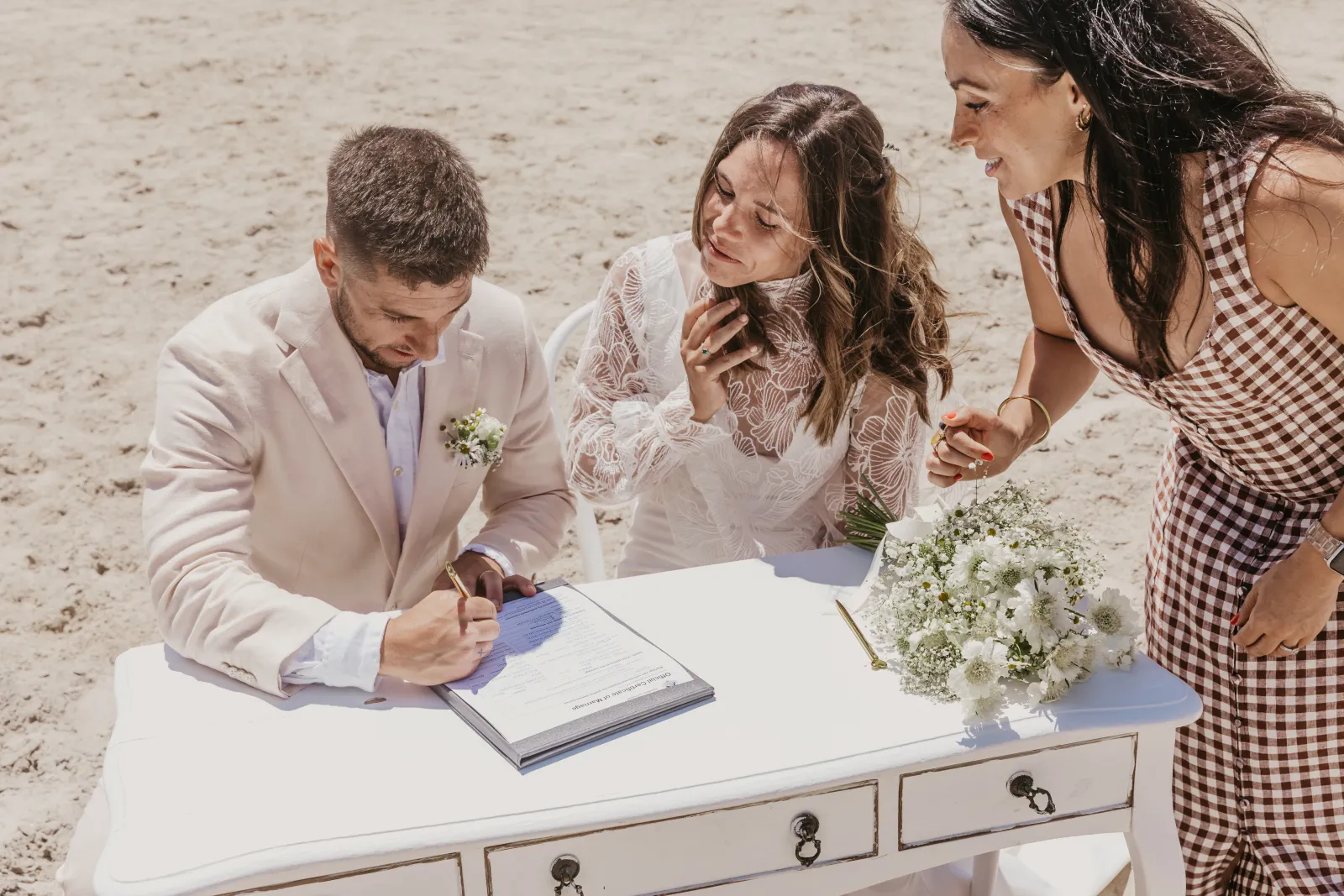
If you've never hired a celebrant before, the job description is genuinely confusing. The ceremony is short, the speaking is brief, the forms get signed, the marriage is done. So why do celebrants charge several hundred at the low end and several thousand at the high? Where does the work go?
Most of it happens before the ceremony, and a chunk happens after. A registered marriage celebrant is three things at once: your legal officiant, your ceremony writer, and your day-of coordinator. Cheap celebrants tend to be cheap because they only show up for the third one.
Australian marriage law has specific paperwork requirements, and a registered celebrant exists primarily to make sure they're done right. The biggest one is the Notice of Intended Marriage, lodged at least one calendar month before the wedding. I sit with you (or jump on a video call), fill it out together, sight your ID documents, and lodge it properly.
On the day, three certificates have to be signed by you, your witnesses, and me, in a specific order with specific wording. Afterwards, I lodge the paperwork with Births, Deaths and Marriages. If any of this is done wrong, the marriage might not be legally valid. It's genuinely the most consequential part of my job and the one couples see least.
This is the part most couples picture when they think about what a celebrant does. The ceremony itself, which I write from scratch around your relationship.
It starts with an initial meeting (about an hour) where I get to know you both: how you met, what makes the relationship work, what you'd want me to say to your guests if you couldn't do it yourselves. From there I draft the script, send it to you, and we revise until it sounds right. A custom ceremony is typically 4 to 6 hours of writing across multiple drafts. A simpler one is 1 to 2 hours. None of this is template work; if it were, every ceremony would sound the same.
A short ceremony isn't less work. The shortest ceremonies often take the longest to get right, because there's nowhere for filler to hide.
I arrive 30 minutes early to set up the audio system, brief witnesses, calm nervous parents, and be a stable point in the middle of what's usually a chaotic morning. I run the ceremony, handle the unexpected (an emotional partner, a flower girl having a moment, a sudden rain shower), and keep the legal elements on track without it feeling like a court proceeding.
Most ceremonies run 20 to 35 minutes. Add arrival and signing, and on-site work is 90 minutes to 2 hours. Add travel and that's a half-day, just for the day-of part.
Gold Coast celebrant prices in 2026 range from about $400 at the budget end (newer celebrants building portfolios, stripped-back legals-only services) to $2,500+ at the premium end. Most full-service celebrants sit between $700 and $1,500. My packages are in the middle: from $550 for Legals Only to $1,350 for a fully personalised Love Story Ceremony.
If you see a celebrant priced at $300 or less, ask what's included. Often: not the paperwork, not the rehearsal, not the certificate, not the lodgement, not the travel. Comparing prices without comparing inclusions doesn't actually tell you anything.
I write fun, down-to-earth ceremonies. I do all the paperwork. Travel is included across my local zone (southern Gold Coast down to Mullumbimby and Brunswick Heads); further afield attracts a small per-kilometre fee. I bring a professional audio system on the Personalised Ceremony and Love Story Ceremony packages. And I put the full 10 to 20 hours into every wedding because that's what the job takes when it's done properly.
If you're shopping around: meet a couple of celebrants and ask each one what's included. The answers will tell you what the market actually looks like.
A rough breakdown of where 10 to 20 hours per wedding actually go.
2-4h
Initial meeting, NOIM lodgement, sighting documents, planning conversations, answering the dozens of small questions couples have before the day.
4-8h
Drafting from scratch, multiple revisions, vows coaching, rehearsing the script. Custom ceremonies sit at the higher end; lighter packages at the lower.
3-5h
Travel, setup, the ceremony itself, signing, post-day paperwork lodgement with Births, Deaths and Marriages. The marriage doesn't end on the day for me.
In Australia, "celebrant" is the standard term and the legal title for someone authorised to perform marriages. "Officiant" is more commonly used in the US. Functionally, in an Australian wedding context, they're the same thing. A registered marriage celebrant is the person who makes the marriage legally valid.
Only if they're a registered marriage celebrant. Australia doesn't have an "officiant for a day" option the way some US states do. If you want a friend to play a role in the ceremony, that's easy (readings, blessings, leading the vows section), but the legal parts have to be performed by someone registered.
Often, yes, for ceremonies with bigger wedding parties or where the venue layout matters. For elopements and small ceremonies, usually no. I'll tell you whether your ceremony actually needs one rather than charging you for one by default.
Sometimes, but it's not the same job and many celebrants don't offer it. I personally focus on the ceremony itself; if you want the same person doing both, ask up front and we'll figure out whether it's a fit.
It's rare but it happens. Established celebrants have backup networks of other registered celebrants who can step in last-minute. I have a couple of trusted celebrants I can call if I were ever genuinely incapacitated. The paperwork I've done in advance (NOIM, certificates) means a backup celebrant can take over without you needing to redo anything.
Send me your date and a couple of sentences about the wedding you're picturing.
Check My Availability